Digital transformation programs carry a special combination of risks: new technology, legacy systems, sensitive data, demanding users and organisational change – all at once. In our webinar on corporate risk management with Alexandre Oliveira, more than 100 participants agreed on one point: most failures were predictable. This framework helps you predict them early and act.
Key takeaways
- Start with risk appetite: how much uncertainty is the organisation willing to accept for the expected value?
- Identify risks across five categories: strategy, people, process, technology & data, external.
- Assess with a simple probability × impact matrix and focus on the top ten.
- Every risk needs an owner, a response and a trigger.
- Review continuously – risks change faster in digital programs.
Why digital programs are riskier than they look
A traditional construction or infrastructure project usually has a stable scope and well-known technology. Digital programs are different: requirements evolve, technology changes during delivery, integrations reveal surprises, and success depends on people adopting new ways of working. Uncertainty is not a sign of bad planning – it is the nature of the work. The goal of risk management is therefore not to eliminate uncertainty, but to make it visible and manageable.
The six-step framework
Step 1: Define risk appetite and objectives
Agree with the sponsor and executive team on what the program must achieve and what is non-negotiable. For example: “No customer data may leave the EU”, “Core banking must not be down for more than four hours”, “Budget overrun above 10% requires board approval.” These statements become the yardstick for every later decision.
Step 2: Identify risks systematically
Run structured workshops with business, IT, security, legal, finance and – importantly – end users. Use a category checklist to avoid blind spots:
| Category | Typical risks in digital transformation |
|---|---|
| Strategy & governance | Unclear objectives, weak sponsorship, competing priorities, benefits not owned |
| People & change | Low adoption, resistance, skills gaps, key-person dependency, change fatigue |
| Process | Automating broken processes, unclear process ownership, operational disruption at go-live |
| Technology & data | Legacy integration, data migration and quality, performance, cybersecurity, technical debt |
| External & commercial | Vendor lock-in or failure, regulation (privacy, AI), market changes, supply chain |
Write each risk as a cause–event–effect statement: “Because legacy customer data contains duplicates (cause), the migration may fail validation (event), delaying go-live by two months (effect).” Vague risks like “data problems” cannot be managed.
Step 3: Assess probability and impact
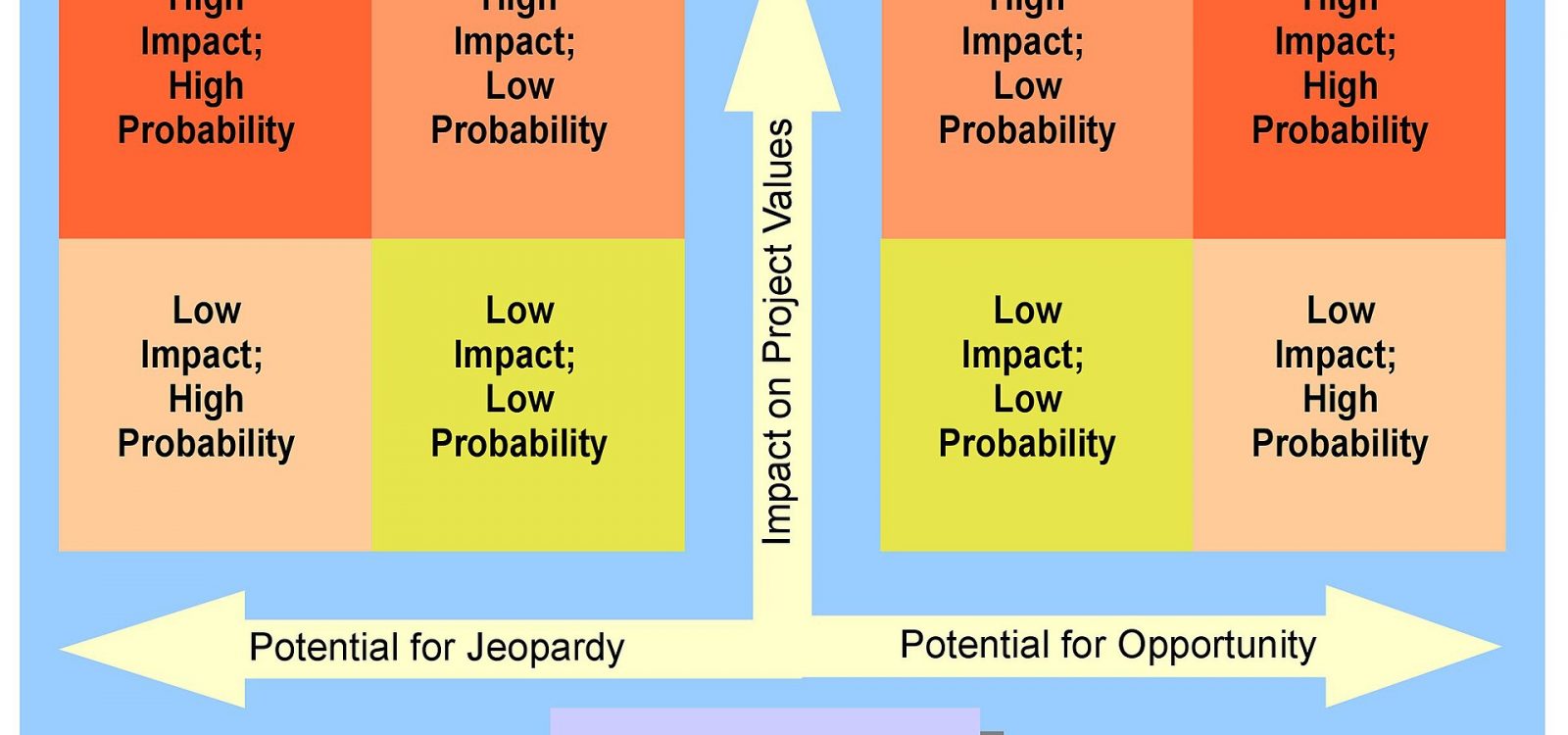
Use a 5×5 probability–impact matrix. Rate impact on the objectives that matter most – cost, schedule, customers, compliance, reputation. Multiply the scores to rank risks, then sanity-check the ranking with experts. Focus management attention on the top ten; monitor the rest.
| Score | Probability | Impact (example: schedule) |
|---|---|---|
| 1 | Rare (<10%) | < 1 week delay |
| 2 | Unlikely (10–30%) | 1–4 weeks |
| 3 | Possible (30–50%) | 1–2 months |
| 4 | Likely (50–80%) | 2–4 months |
| 5 | Almost certain (>80%) | > 4 months / program at risk |
For large programs, add quantitative analysis for the biggest uncertainties – for example a Monte Carlo simulation of the schedule – to set realistic contingency.
Step 4: Plan responses
For each significant threat, choose a strategy: avoid (change the plan to remove it), mitigate (reduce probability or impact), transfer (contract, insurance) or accept (with contingency). Do not forget opportunities – risks with positive effects – which you can exploit, enhance or share.
- Data migration risk: profile and cleanse data early, run trial migrations, define go/no-go criteria.
- Adoption risk: involve users in design, train champions, phase the rollout, measure usage.
- Vendor risk: include exit clauses, escrow, clear service levels and acceptance criteria.
- Cybersecurity risk: security by design, penetration tests before go-live, incident response plan.
- Key-person risk: pair people, document knowledge, cross-train.
Step 5: Assign owners and triggers
A risk without an owner is nobody’s risk. The owner is the person best placed to manage it – not automatically the project manager. Define triggers: observable signals that a risk is materialising (“test defects above 50 per week”, “user logins below 40% after two weeks”). Triggers turn the risk register into an early-warning system.
Step 6: Monitor, report and learn
Review the top risks in every steering meeting and the full register at least monthly. Report trends – is overall exposure going up or down? – rather than long lists. After each phase, capture lessons learned and update your organisation’s risk checklist so the next program starts smarter.
Special attention: data protection and AI
Many digital programs now include analytics or AI components. Add specific risks for personal data processing, model bias, explainability and regulatory compliance. Involve the data protection officer early and document decisions. Our article on AI and machine learning in project management lists practical controls.
Corporate risk management connects the dots
Project risks should not live in isolation. Escalate risks that exceed the program’s authority to the corporate risk register, and align with enterprise risk management so that the board sees the cumulative exposure of all transformation initiatives. This is where project management meets the Business Environment domain – now 26% of the updated PMP® exam.
Templates you can start with today
A minimum viable risk register has these columns: ID, category, cause–event–effect description, probability, impact, score, owner, response strategy, actions, trigger, status, last review date. Keep it simple enough that people actually update it.
When to ask for an independent view
If the risk picture is unclear, if several top risks have materialised, or if stakeholders disagree on the level of exposure, an external project audit provides an objective assessment. Through Corporate Consulting, we also help organisations set up risk processes for their transformation portfolios.
Frequently asked questions
The most frequent are unclear business objectives, low user adoption, data quality and migration problems, integration with legacy systems, cybersecurity and vendor dependency, and change fatigue.
Review top risks at every steering meeting and the full register at least monthly – and immediately after any major change in scope, vendor or regulation.